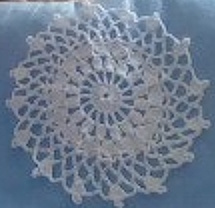
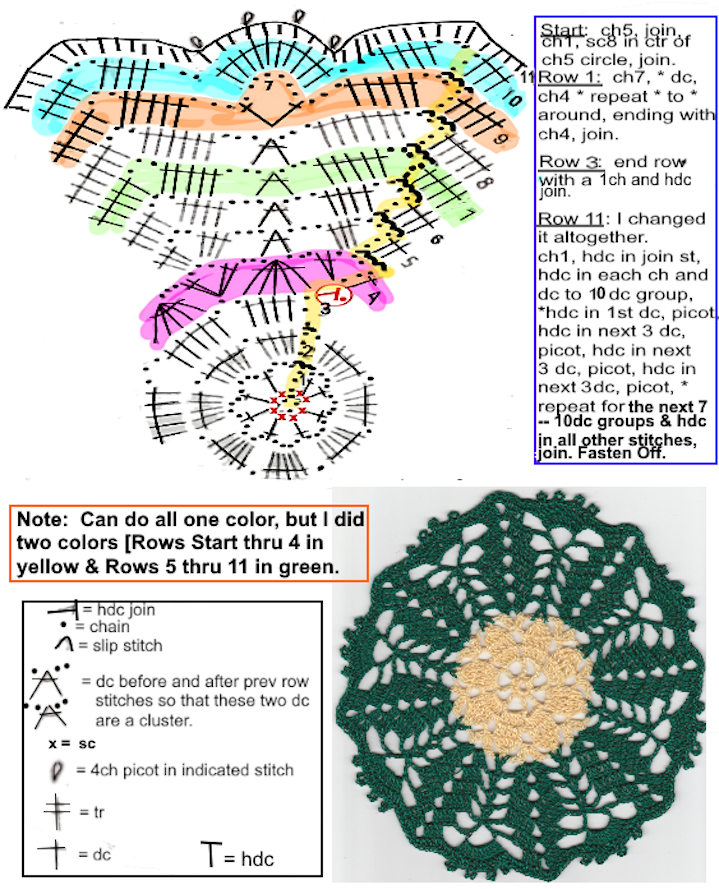
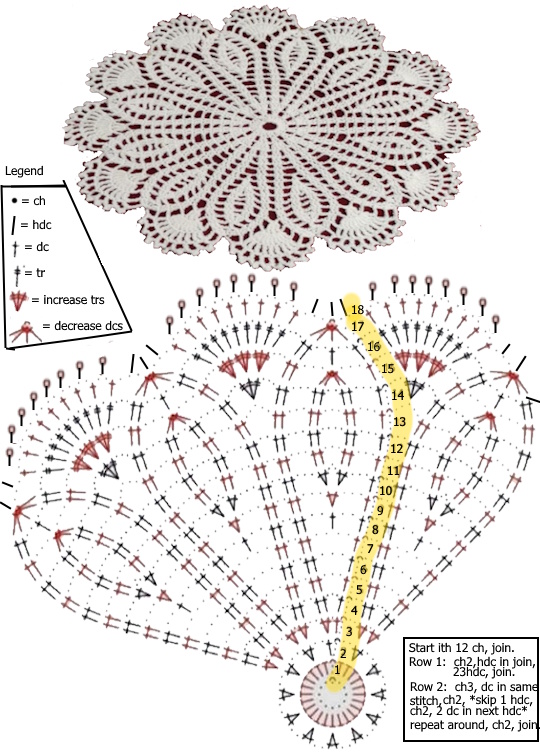
Changed 9ch to 7ch to start doily and suggested a magic ring instead.
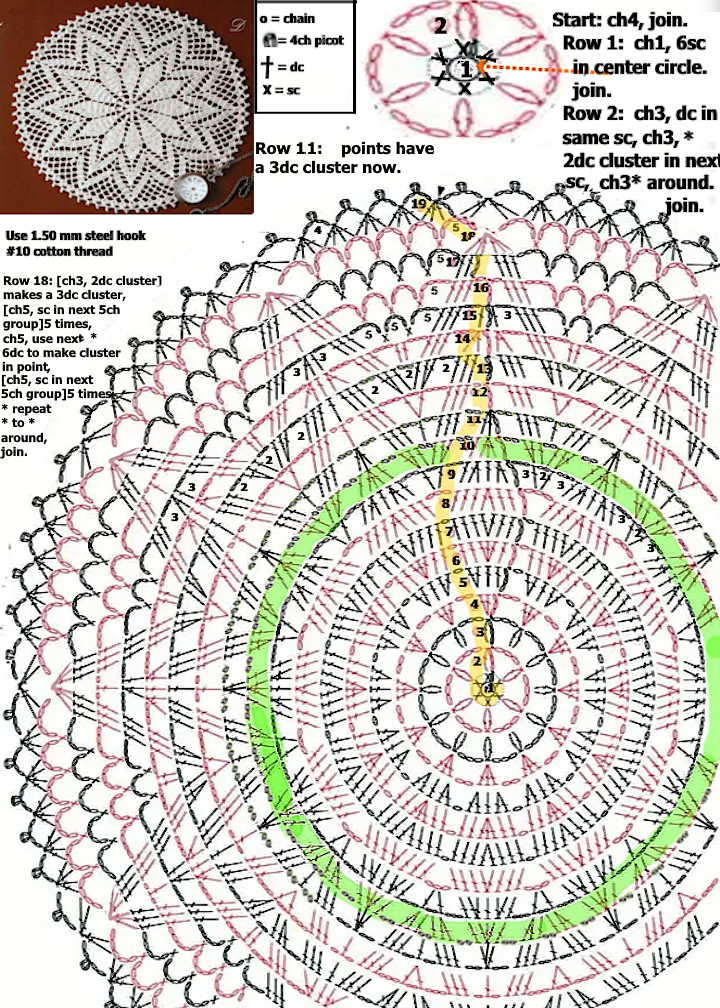
Changed Rows 13, 14, 15 and the diagram.
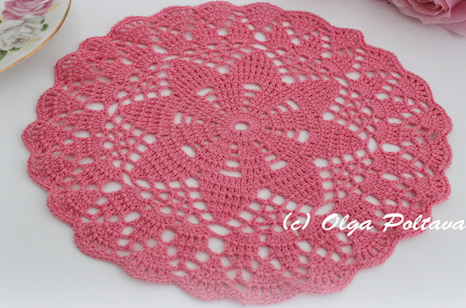
The version below has rows 11, 15, and 16 altered.
Row 16 has been changed from sc to hdc throughout row.
Abbreviations:
- ch: chain
- dc: double crochet
- tr: treble crochet
- dc2-tog: 2 double crochet finished together (also known as dc 2 decrease)
- dc3-tog: 3 double crochet finished together (also known as dc 3 decrease)
- dc4-tog: 4 double crochet finished together (also known as dc 3 decrease)
- sl st: slip stitch
- st: stitch
- * *instructions between asterisks should be repeated as many times as there are stitches to accommodate.
- { } instructions within brackets should be repeated as many times as stated.
———————————–
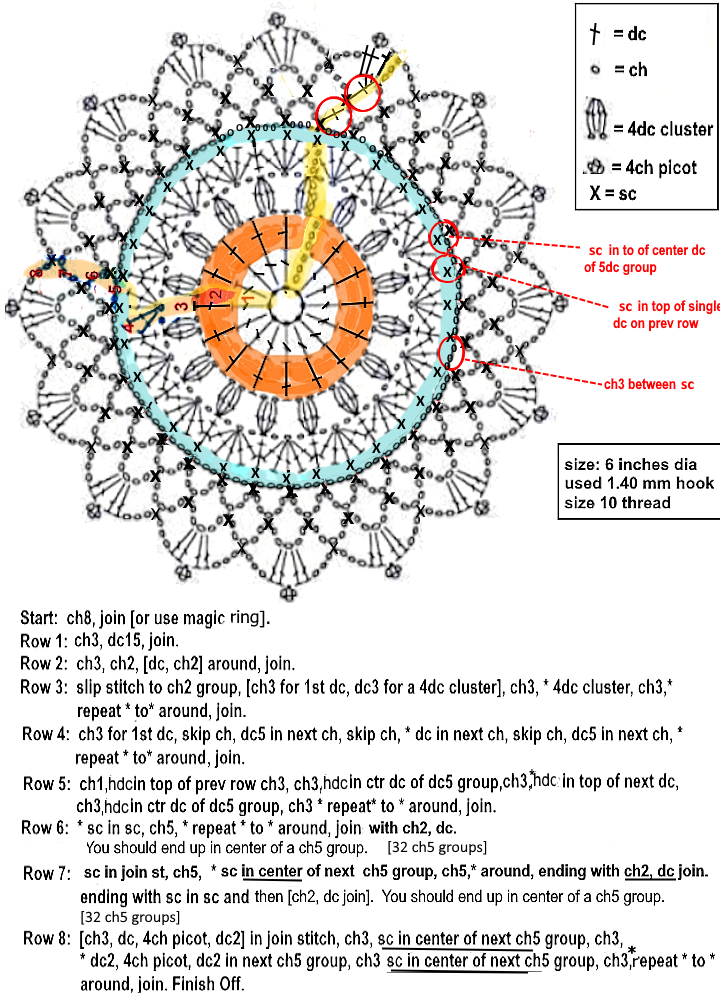
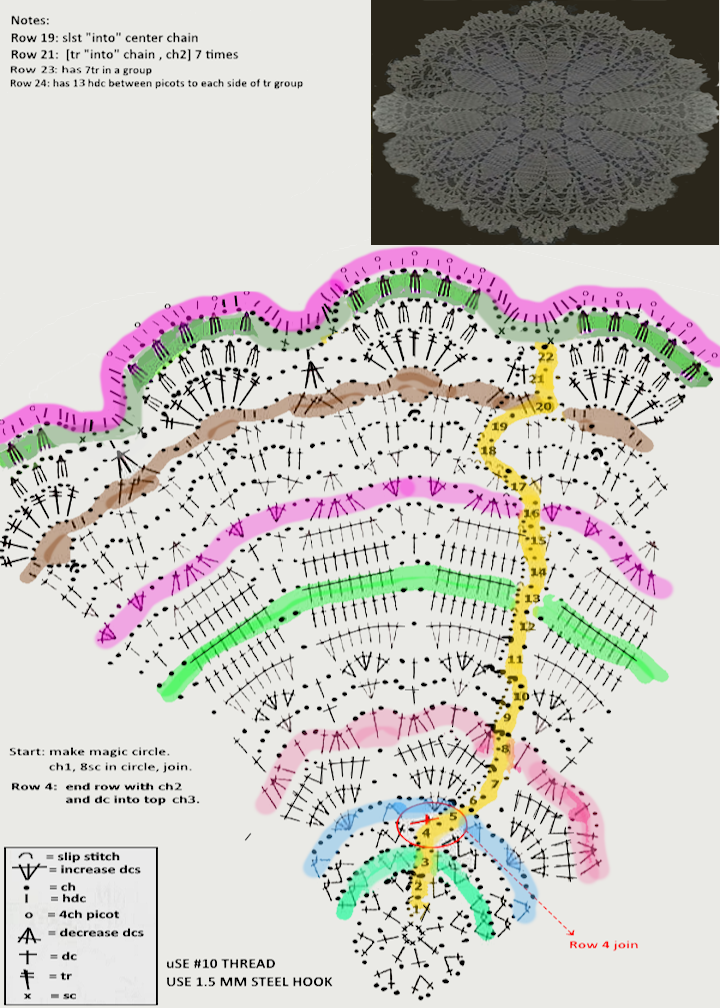
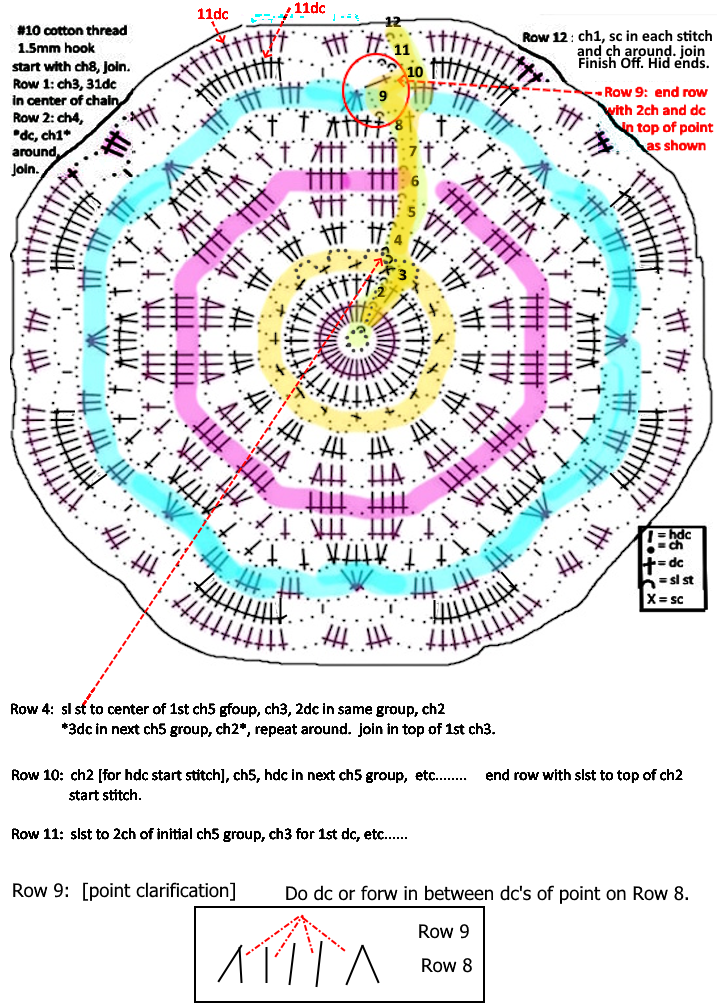
Ch 7, join with sl st in ring. [or use a magic ring instead]
Round 1: ch 3 (counts as 1st dc here and throughout), 23 dc in ring; join with sl st to 3rd ch of beginning ch-3. (24 dc)
Round 2: ch 3, dc in next 2 dc, ch 2, *dc in next 3 dc, ch 2* around; join with sl st to 3rd ch of beginning ch-3.
Round 3: ch 3, dc in same space as joining, dc in next dc, 2 dc in next dc, ch 2, *2 dc in next dc, dc in next dc, 2 dc in next dc, ch 2* around; join.
Round 4: ch 3, dc in next 4 dc, ch 3, *dc in next 5 dc, ch 3* around; join.
Round 5: ch 3, dc in next 4 dc, ch 4, *dc in next 5 dc, ch 4* around; join.
Round 6: ch 3, dc in next dc, (dc, ch 2, dc) all in next dc, dc in next 2 dc, dc in each of next 4 ch, *dc in next 2 dc, (dc, ch 2, dc) all in next dc, dc in next 2 dc, dc in each of next 4 ch* around; join.
Round 7: ch 3, dc2-tog over next 2 dc, ch 5, *dc2-tog over next 2 dc, dc in next 6 dc, dc2-tog over next 2 dc, ch 5* around, end with dc2-tog over next 2 dc, dc in next 5 dc; join.
Round 8: sl st to 3rd ch of next ch-5, ch 6 (counts as dc and ch 3), dc in same ch, ch 2, dc2-tog over next dc2-tog and dc, dc in next 4 dc, dc2-tog over next dc and dc2-tog, ch 2, *(dc, ch 3, dc) all in 3rd ch of next ch-5, ch 2, dc2-tog over next dc2-tog and dc, dc in next 4 dc, dc2-tog over next dc and dc2-tog, ch 2* around; join with sl st to 3rd ch of beginning ch-6.
Round 9: ch 6 (counts as dc and ch 3), dc in same st as joining, (dc, ch 3, dc) all in next dc, ch 2, dc2-tog over next dc2-tog and dc, dc in next 2 dc, dc2-tog over next dc and dc2-tog, ch 2, *{(dc, ch 3, dc) all in next dc} twice, ch 2, dc2-tog over next dc2-tog and dc, dc in next 2 dc, dc2-tog over next dc and dc2-tog, ch 2* around; join with sl st to 3rd ch of beginning ch-6.
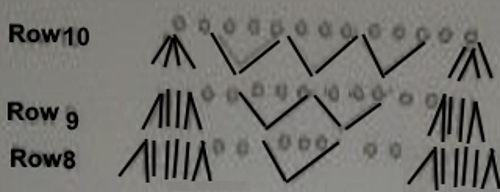
Round 10: ch 6 (counts as dc and ch 3), dc in same st as joining, (dc, ch 3, dc) all in space between next 2 dc, skip next ch-3, (dc, ch 3, dc) all in next dc, ch 2, skip next ch-2, dc4-tog over next 4 st (over dc2-tog, 2 dc, and dc2-tog), ch 2, *(dc, ch 3, dc) all in next dc, (dc, ch 3, dc) all in space between next 2 dc, skip next ch-3, (dc, ch 3, dc) all in next dc, ch 2, skip next ch-2, dc4-tog over next 4 st, ch 2* around; join with sl st to 3rd ch of beginning ch-6.
Round 11: sl st in next ch-3 space, ch 3, 6 dc in same ch-3 space, ch 1, {7 dc in next ch-3 space, ch 1} twice, skip next ch-2 space, dc4-tog, and ch-2 space,– then ch1, *{7 dc in next ch-3 space, ch 1} three times, skip next ch-2 space, dc4-tog, and ch-2 space*, — then ch1, around; join with sl st to 3rd ch of beginning ch-3.
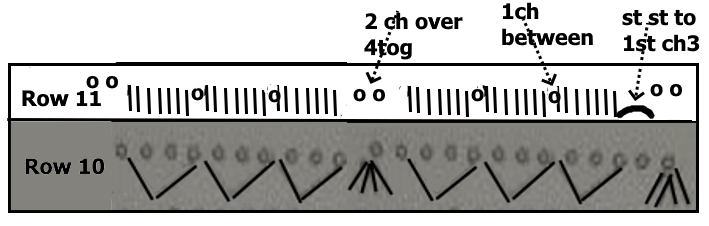
Round 12: sl st in next dc, ch 3, dc in next 4 dc, ch 3, skip next dc, ch-1, and dc, *dc in next 5 dc, ch 3, skip next dc, ch-1, and dc* around; join.
Round 13: sl st in next dc, ch 3, dc in next 2 dc, ch 2, 3 dc in 2nd ch of next ch-3, ch 2, skip next dc, *dc in next 3 dc, ch 2, skip next dc, 3 dc in 2nd ch of next ch-3, ch 2, skip next dc* around; join.
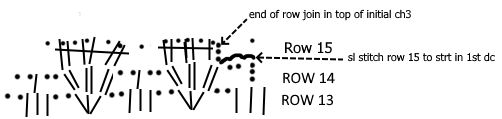
Round 14: sl st in next dc, ch 5 (counts as 1st dc and ch 2), skip next dc, 2 dc in each of next 3 dc, ch 2, *skip next dc, dc in next dc, ch 2, skip next dc, 2 dc in each of next 3 dc, ch 2,* around; join with sl st to 3rd ch of beginning ch-5.
Round 15: sl st to next dc, ch 4 (counts as 1st dc and ch 1), {dc in next dc, ch 1} five times, [skip next ch-2, dc, and ch-2,] *{dc in next dc, ch 1} six times, [skip next ch-2, dc, and ch-2]* around; join with sl st to 3rd dc of beginning ch-4.
Round 16: hdc in same st as joining. Hdc in each dc and ch around. Join with sl st to 1st hdc.
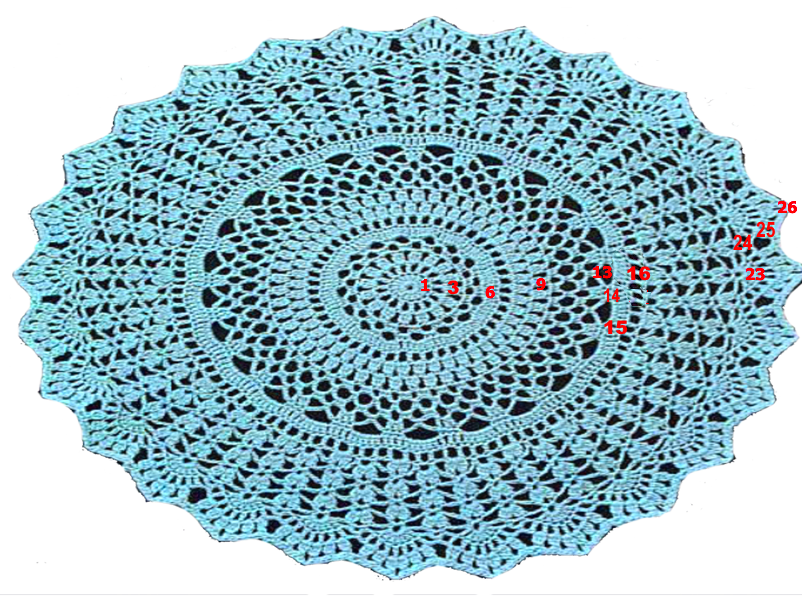
Fasten off. Block.