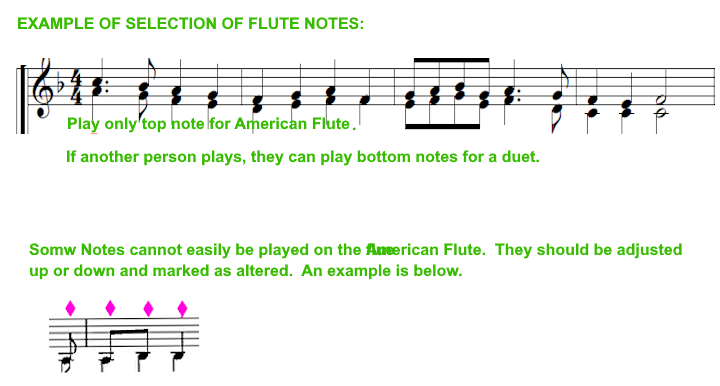
The 6 hole flute music theory is not exactly the same as piano music theory. It helps to learn such theory anyway. The American flute music theory is an adaption of such theory for reading sheet music and making your own adaptions.
American Indian flute theory centers on a two-chambered, duct-flute design that acts as an instrumentalization of vocal, courtship traditions, typically producing a minor pentatonic scale. Traditionally rooted in indigenous oral history, modern theory focuses on the Nakai TABlature system and pentatonic scales, with many flutes featuring 5 or 6 holes to create a “safe” scale that avoids dissonance.
There is a theory that the modern NAF has been created by Native Americans based on the European church pipe organs which work in similar way, or maybe the Native Americans copied the way recorders were made.

Music theory is the study of the fundamental elements that govern the language of music—including notes, scales, chords, rhythm, melody, and harmony. It acts as a framework for understanding how music is constructed, analyzed, and performed, functioning as a set of guidelines rather than rigid rules for composing and interpreting musical ideas.
You can absolutely teach yourself music theory. It is a highly self-teachable subject, though it requires dedication, as it can be slow-going initially. Numerous free and paid resources, including websites like musictheory.net, YouTube channels, and books, provide comprehensive lessons on the staff, rhythm, chords, and scales.
- The fundamental building blocks, including notes (\(A\)-\(G\)), sharps/flats, and their representation on a staff.Intervals: The distance between two notes, which forms the basis for melody and harmony.
- Scales: Sequences of notes that establish the key (e.g., Major, Minor, Pentatonic), providing a “mood” for music.
- Chords and Harmony: Groups of notes played simultaneously, forming chords and chord progressions that create harmonic, vertical structures.
- Rhythm: The organization of sound over time, including tempo, meter, and note values.
- Form: The structure or arrangement of a piece of music (e.g., verse-chorus, sonata)
- Communication: Provides a common language for musicians to discuss, write, and analyze music, according to a Reddit post in r/Guitar.
- Composition and Improvisation: Helps creators understand which notes and chords work well together.
- Performance: Assists performers in interpreting complex rhythms, harmonies, and dynamics.
- Production: Enables producers to communicate effectively with musicians and structure arrangements
Music theory involves pattern recognition, logic, and memorization of cultural conventions, while math focuses on abstract calculation. While basic music theory is simpler than high-level calculus, advanced music theory can become deeply abstract, similar to complex math.
Flute players learn to take deep, controlled breaths to sustain the air and produce long notes. This practice can expand lung capacity, which is beneficial for overall respiratory health. Jaffa and her co-investigators, including researchers from Rush University Medical Center (Chicago, IL) and Hennepin Healthcare (Minneapolis, MN), found that older adults who participated frequently in musical activities showed lower risk for dementia, compared with older adults who did those activities rarely if ever.
You can practice the flute for fifteen or twenty minutes and accomplish easily what someone else does in an hour just by focusing on your practice guide and keeping yourself on point. As well as stopping to check your physical technique often.
You should swab the inside of your flute and wipe the outside with a polishing cloth after every use to remove moisture and fingerprints. A professional, in-depth cleaning (COA: Clean, Oil, and Adjust) is recommended once a year, or every 12–18 months for regular players, to keep pads and mechanisms in top condition.
============================
============================
Some online sources on flute theory and piano theory:
- https://www.thriftbooks.com [Music Theory Book]
- https://folklife.si.edu/magazine/north-american-indigenous-flute-kevin-locke
- PDF files that may be helpful